When to use this letter
Use this letter when coverage appears to apply, the claim is documented, and the insurer has delayed, underpaid, denied, or not yet had a clear chance to settle. Typical cases:
- A first-party claim under your client's own policy, such as property, uninsured motorist or disability, that has stalled or been denied.
- A claim paid far below the documented loss, with no clear explanation.
- A denial that relies on an exclusion or condition the facts do not seem to support.
- A third-party injury claim where damages clearly exceed the insured's limits and you want to make a time-limited offer to settle within them.
Bad faith law differs between first-party and third-party claims, and both vary by state. Some states set strict rules for time-limited demands or require written notice before a bad faith suit, including terms, delivery method and response periods. The draft leaves a placeholder for these rules; your attorney must complete it.
What to upload
Upload up to 5 PDFs, 500 pages in total. The policy and the claim history matter as much as the proof of loss here.
- The policy
- The declarations page and the full policy form, including endorsements, so the draft can quote the coverage grant and any exclusion at issue.
- Denial or reservation of rights letters
- Every coverage position letter, with the reasons given.
- Claim correspondence
- Letters and emails with the adjuster, document requests, your responses and any limits disclosure.
- Proof of loss
- Medical records and bills for injury claims, or estimates and photos for property claims. For third-party claims, add the police or incident report.
- Payment records
- Any partial payments, explanation of benefits or payment letters, so the draft can show what remains unpaid.
Evidence checklist
Gather these before you write. Start with the ones marked "Most important".
- The policyMost important The declarations page and the full policy form, including endorsements, so the draft can quote the coverage grant and any exclusion at issue.
- Denial or reservation of rights lettersMost important Every coverage position letter, with the reasons given.
- Claim correspondenceHelps Letters and emails with the adjuster, document requests, your responses and any limits disclosure.
- Proof of lossHelps Medical records and bills for injury claims, or estimates and photos for property claims. For third-party claims, add the police or incident report.
- Payment recordsHelps Any partial payments, explanation of benefits or payment letters, so the draft can show what remains unpaid.
What the draft includes
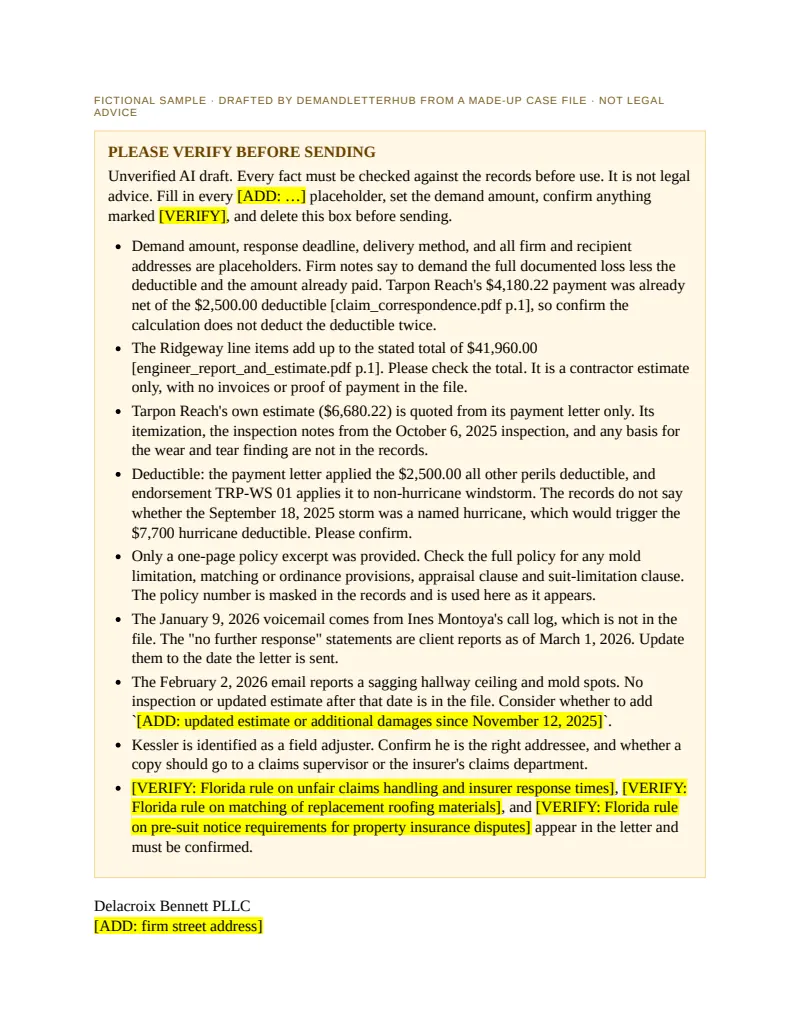
An editable Word letter built only from what your documents say. Missing facts become [ADD: …] placeholders, never guesses, and any law cited is marked [VERIFY].
- Please verify box. A short notice at the top reminding the reviewer that this is an unverified AI draft.
- Claim and coverage details. Insured, claimant, policy and claim numbers, date of loss and the limits, as the documents state them.
- Coverage analysis. The policy language that applies, quoted and cited, and why the denial or exclusion does not fit, from the documents only.
- Claim timeline. When the claim was reported, what was sent and requested, and each response or silence, in date order.
- The loss. Injuries and treatment with medical specials, or property damage with a costs table, each cited to its record or bill.
- Offer or demand. The offer terms and release for a limits offer, or the amount owed on a first-party claim, plus the deadline. All placeholders for your attorney.
- Statutory requirements placeholder. An [ADD] section for your state's demand and notice rules, so nothing is assumed.
Before you send it
The result is an unverified AI draft for attorney review, not legal advice.
- Confirm whether your state has a time-limited demand or pre-suit notice statute, and follow it exactly.
- Verify the limits, the named insureds and all available policies, including umbrella and excess.
- Define the offer terms, release, lien handling and payment conditions.
- Set the amount, a reasonable deadline and the delivery method, and remove the Please verify box.
Common mistakes
Insurers read these letters closely, and so do courts later. Small errors can give the carrier a reason to reject the demand or a defense to a bad faith claim.
- Not confirming the coverage Ask for the certified policy and disclosure of all policies, including umbrella and excess. A demand built on the wrong form or the wrong limits may not set up the claim you intend.
- Unclear release terms If the required release is vague, or reaches parties or claims beyond the insured, the carrier may say it could not accept. Spell out who is released and from what.
- Ignoring liens Medical and health plan liens affect whether the carrier can safely pay. Say how liens will be handled, or the insurer may argue the offer was not one it could accept.
- No proof of what the insurer had A bad faith claim often turns on what the carrier knew and when. Send a complete file, list the enclosures in the letter, and keep proof of delivery.
Free insurance claim / bad faith demand letter template
Prefer to write it yourself? Download a plain Word template with fields to fill in. No AI, no email needed. Sample template, not legal advice.
Questions
Is the insurance claim / bad faith demand letter free?
Yes. No account and no payment.
Does it work for my client's own insurer as well as the other side's?
Yes. Use it for a delayed or denied first-party claim, or for a time-limited offer to a liability insurer.
Will this letter create a bad faith claim?
No letter guarantees that. Whether an insurer acted in bad faith depends on state law and the facts. The draft helps you present a clear, documented demand.
What happens to the documents I upload?
They are used only to draft the letter and deleted as soon as the draft is generated. The Word file is deleted after 48 hours or 3 downloads.