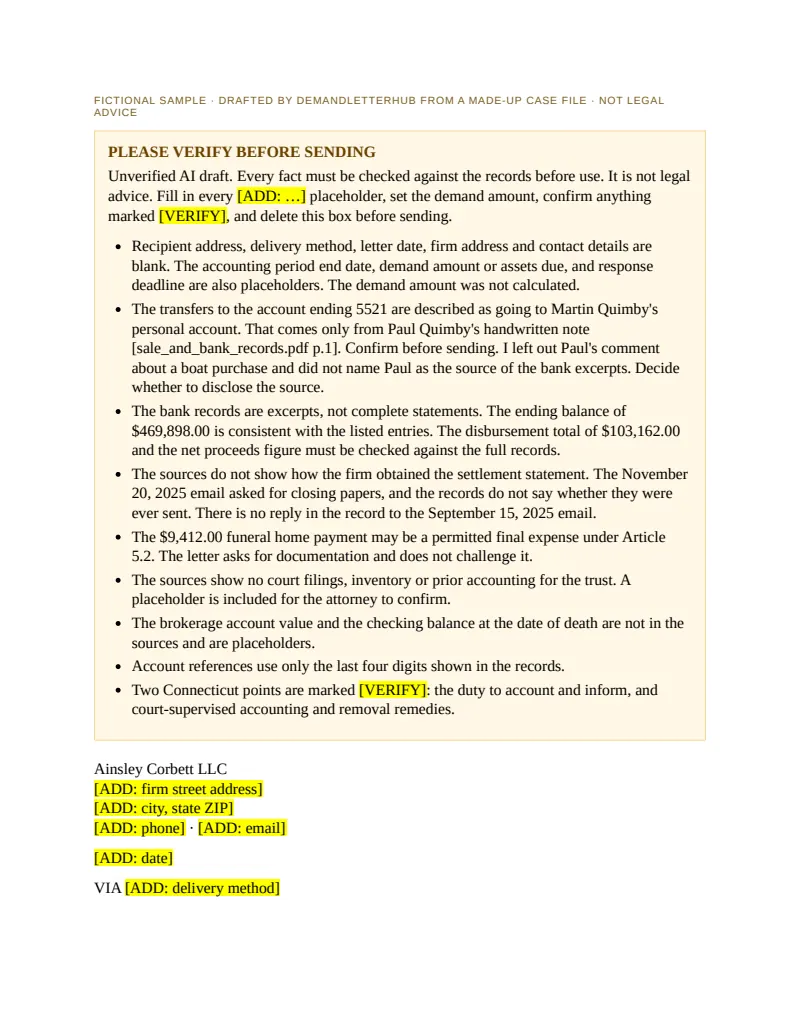
PLEASE VERIFY BEFORE SENDING
Unverified AI draft. Every fact must be checked against the records before use. It is not legal advice. Fill in every [ADD: …] placeholder, set the demand amount, confirm anything marked [VERIFY], and delete this box before sending.
- Recipient address, delivery method, letter date, firm address and contact details are blank. The accounting period end date, demand amount or assets due, and response deadline are also placeholders. The demand amount was not calculated.
- The transfers to the account ending 5521 are described as going to Martin Quimby's personal account. That comes only from Paul Quimby's handwritten note [sale_and_bank_records.pdf p.1]. Confirm before sending. I left out Paul's comment about a boat purchase and did not name Paul as the source of the bank excerpts. Decide whether to disclose the source.
- The bank records are excerpts, not complete statements. The ending balance of $469,898.00 is consistent with the listed entries. The disbursement total of $103,162.00 and the net proceeds figure must be checked against the full records.
- The sources do not show how the firm obtained the settlement statement. The November 20, 2025 email asked for closing papers, and the records do not say whether they were ever sent. There is no reply in the record to the September 15, 2025 email.
- The $9,412.00 funeral home payment may be a permitted final expense under Article 5.2. The letter asks for documentation and does not challenge it.
- The sources show no court filings, inventory or prior accounting for the trust. A placeholder is included for the attorney to confirm.
- The brokerage account value and the checking balance at the date of death are not in the sources and are placeholders.
- Account references use only the last four digits shown in the records.
- Two Connecticut points are marked [VERIFY]: the duty to account and inform, and court-supervised accounting and removal remedies.
Ainsley Corbett LLC
[ADD: firm street address]
[ADD: city, state ZIP]
[ADD: phone] · [ADD: email]
[ADD: date]
VIA [ADD: delivery method]
Martin Quimby, Trustee
Harold J. Quimby Revocable Trust
[ADD: street address]
[ADD: city, state ZIP]
Re: Demand for Trust Accounting and Distribution, Harold J. Quimby Revocable Trust; Beneficiary: Rebecca Lindahl; Settlor's date of death: February 11, 2025
Dear Mr. Quimby:
Introduction
We represent Rebecca Lindahl, a one-third beneficiary of the Harold J. Quimby Revocable Trust (the "Trust") [firm notes]. You serve as Successor Trustee [trust_agreement_excerpt.pdf p.1]. Please direct all further communication about the Trust to this office. We write to request a full accounting of the Trust from the Settlor's death, an explanation of certain withdrawals from the Trust account, and distribution of our client's share of the proceeds of the sale of the residence.
The Trust and the administration
The Trust Agreement is dated May 9, 2018, as amended June 3, 2022, and names you as Successor Trustee [trust_agreement_excerpt.pdf p.1]. Harold J. Quimby died on February 11, 2025 [trust_agreement_excerpt.pdf p.1], and the Trust became irrevocable at his death [trust_agreement_excerpt.pdf p.1, Art. 4.1]. The Trust Agreement provides that it is governed by Connecticut law [trust_agreement_excerpt.pdf p.1, Art. 10.2]. The provisions most relevant here are these:
- Division at death (Art. 5.2): "After payment of the Settlor's final expenses and taxes, the Trustee shall divide the remaining trust estate into three equal shares, one each for the Settlor's children, Martin Quimby, Rebecca Lindahl and Paul Quimby, and shall distribute each share outright as soon as reasonably practicable." [trust_agreement_excerpt.pdf p.1]
- Accounts (Art. 7.3): "The Trustee shall keep accurate records and shall provide to each beneficiary, at least annually and on reasonable request, a written account showing receipts, disbursements and assets on hand." [trust_agreement_excerpt.pdf p.1]
- Real property (Art. 7.5): the Trustee "may sell any real property of the trust at fair market value." [trust_agreement_excerpt.pdf p.1]
- Compensation (Art. 8.1): "An individual Trustee who is a beneficiary shall serve without compensation, but may be reimbursed for reasonable expenses supported by receipts." [trust_agreement_excerpt.pdf p.1]
As amended, Schedule A lists the residence at 26 Orchard Knoll Road, Westbrook Hollow, Connecticut; a brokerage account at Ridgefield Point Securities (account ending 8840); and a checking account at Charter Oak Valley Bank (account ending 1192) [trust_agreement_excerpt.pdf p.1].
[ADD: any court filings relating to the Trust, with dates, or confirmation that none have been made]
What our client has received and what is missing
Our client has asked you in writing for information several times:
- On April 14, 2025, she asked for a list of what was in the Trust and when things would be divided [requests_and_replies.pdf p.1]. On April 30, 2025, you replied that the Trust was "mostly the house and the brokerage account" and that you would "get you something once the house sells." [requests_and_replies.pdf p.1]
- The residence closed on August 22, 2025 [sale_and_bank_records.pdf p.1]. On September 15, 2025, our client asked for a written account under the Trust and for the date of distribution of the shares [requests_and_replies.pdf p.1].
- On November 20, 2025, she made a second request. She asked for statements for the bank and brokerage accounts since February 11, 2025, and for the closing papers [requests_and_replies.pdf p.1].
- On December 4, 2025, you replied that you would "send a summary when the brokerage account is sorted out" and that "[t]here are still some bills." [requests_and_replies.pdf p.1]
As of February 2, 2026, our client had received no accounting, statement or distribution, and no statements for the brokerage account ending 8840 had been provided to her [requests_and_replies.pdf p.1]. The value of that account at the date of death is not known to her [requests_and_replies.pdf p.1]. Roughly ten months have passed since the Settlor's death, and the house sold more than five months ago, yet no written account has been given despite the requests above and the requirements of Article 7.3.
Assets and transactions at issue
The Charter Oak Valley Bank statement excerpts for the Trust account ending 1192 show the following [sale_and_bank_records.pdf p.1]:
| Asset or transaction | Date | Amount | Source |
|---|
| Sale of 26 Orchard Knoll Road: sale price | August 22, 2025 | $612,000.00 | [sale_and_bank_records.pdf p.1] |
| Commission and closing costs | August 22, 2025 | $38,940.00 | [sale_and_bank_records.pdf p.1] |
| Net proceeds, wired to account ending 1192 | Closing August 22, 2025; deposit shown August 25, 2025 | $573,060.00 | [sale_and_bank_records.pdf p.1] |
| Transfer to account ending 5521, memo "advance" | September 2, 2025 | $45,000.00 | [sale_and_bank_records.pdf p.1] |
| Check 1018 to Lakeshore Marine Sales | September 30, 2025 | $28,750.00 | [sale_and_bank_records.pdf p.1] |
| Transfer to account ending 5521, memo "trustee fees" | October 14, 2025 | $20,000.00 | [sale_and_bank_records.pdf p.1] |
| Check 1022 to Hollow Ridge Funeral Home | November 3, 2025 | $9,412.00 | [sale_and_bank_records.pdf p.1] |
| Total of the four disbursements (as read from the bills) | | $103,162.00 | [sale_and_bank_records.pdf p.1] |
| Ending balance, account ending 1192 | December 31, 2025 | $469,898.00 | [sale_and_bank_records.pdf p.1] |
| Brokerage account ending 8840, value at date of death | February 11, 2025 | [ADD: value at date of death] | [trust_agreement_excerpt.pdf p.1] |
| Account ending 1192, balance at date of death | February 11, 2025 | [ADD: balance at date of death] | [trust_agreement_excerpt.pdf p.1] |
We understand the account ending 5521 to be your personal account [sale_and_bank_records.pdf p.1]. The two transfers to it total $65,000.00 as read from the statement. Article 8.1 provides that an individual Trustee who is a beneficiary serves without compensation and may be reimbursed only for reasonable expenses supported by receipts [trust_agreement_excerpt.pdf p.1]. We are not aware of any basis for a payment described as "trustee fees," and we are not aware of what the payment to Lakeshore Marine Sales was for. Article 5.2 calls for three equal shares, and we do not know the basis for a payment described as an "advance."
Demand
On behalf of Ms. Lindahl, we demand that you provide the following by [ADD: response deadline]:
- A full written account of the Trust under Article 7.3 from February 11, 2025 through [ADD: accounting period end date]. It must show all receipts, disbursements and assets on hand.
- Complete statements from February 11, 2025 to the present for the brokerage account ending 8840, the checking account ending 1192, and any other account holding Trust assets.
- The complete closing documents for the sale of 26 Orchard Knoll Road, and the basis on which the sale price was determined under Article 7.5.
- A written explanation of each of the following, with supporting documents:
- the $45,000.00 transfer on September 2, 2025 described as an "advance";
- the $28,750.00 check to Lakeshore Marine Sales;
- the $20,000.00 transfer on October 14, 2025 described as "trustee fees," including the Trust provision relied on in light of Article 8.1; and
- the $9,412.00 check to Hollow Ridge Funeral Home, with the invoice.
- Receipts for any expenses for which you have been or intend to be reimbursed, and an itemized list of the "bills" referred to in your December 4, 2025 email, together with any final expenses and taxes you contend must be paid before division under Article 5.2.
- Distribution to Ms. Lindahl of [ADD: demand amount or assets due], being her one-third share under Article 5.2, as soon as reasonably practicable. If you contend that any amount must be held in reserve, please identify the amount and the reason in writing.
Please preserve all records relating to the Trust, including bank and brokerage records, correspondence, receipts and records of the account ending 5521 to the extent it received Trust funds. If we do not receive a complete response by the date above, Ms. Lindahl reserves all rights and remedies, including petitioning the court for an accounting and for other relief.
Jurisdiction points
The Trust Agreement is governed by Connecticut law [trust_agreement_excerpt.pdf p.1, Art. 10.2]. Under Connecticut practice generally, a trustee must keep beneficiaries reasonably informed about the trust and its administration and must account for the trust property. [VERIFY: Connecticut rule on a fiduciary's duty to account and to inform beneficiaries] A beneficiary who does not receive an accounting may ask the court to supervise one and may seek other relief where warranted. [VERIFY: Connecticut rule on court-supervised accounting and removal remedies]
We would prefer to resolve this without court involvement and look forward to your prompt response.
Sincerely,
Margaret T. Ainsley
Ainsley Corbett LLC